


Understand the latest news, focus on industry trends, interpretation of professional encyclopedia
 Quick Answer
Neither type of fan is universally better. Traditional fans are generally a practical choice when low purchase cost and basic airflow are the main priorities. Bladeless fans can be a better option when safety, modern design, easy cleaning, and product differentiation are more important. For businesses, the right choice depends on the target market, product positioning, selling price, application, and customization requirements.
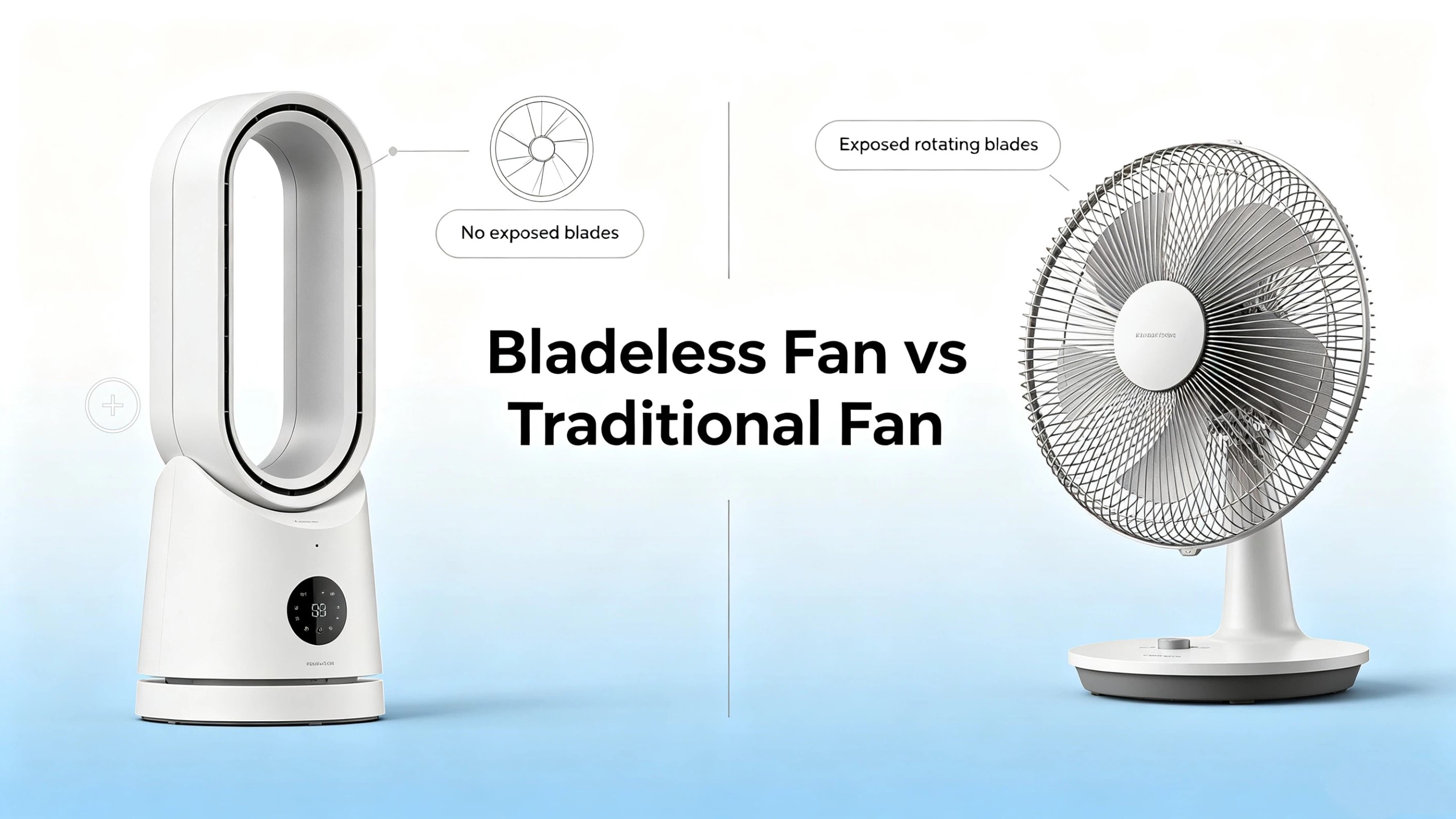
Bladeless and traditional fans use different designs to deliver airflow, which affects how they are positioned in the market.
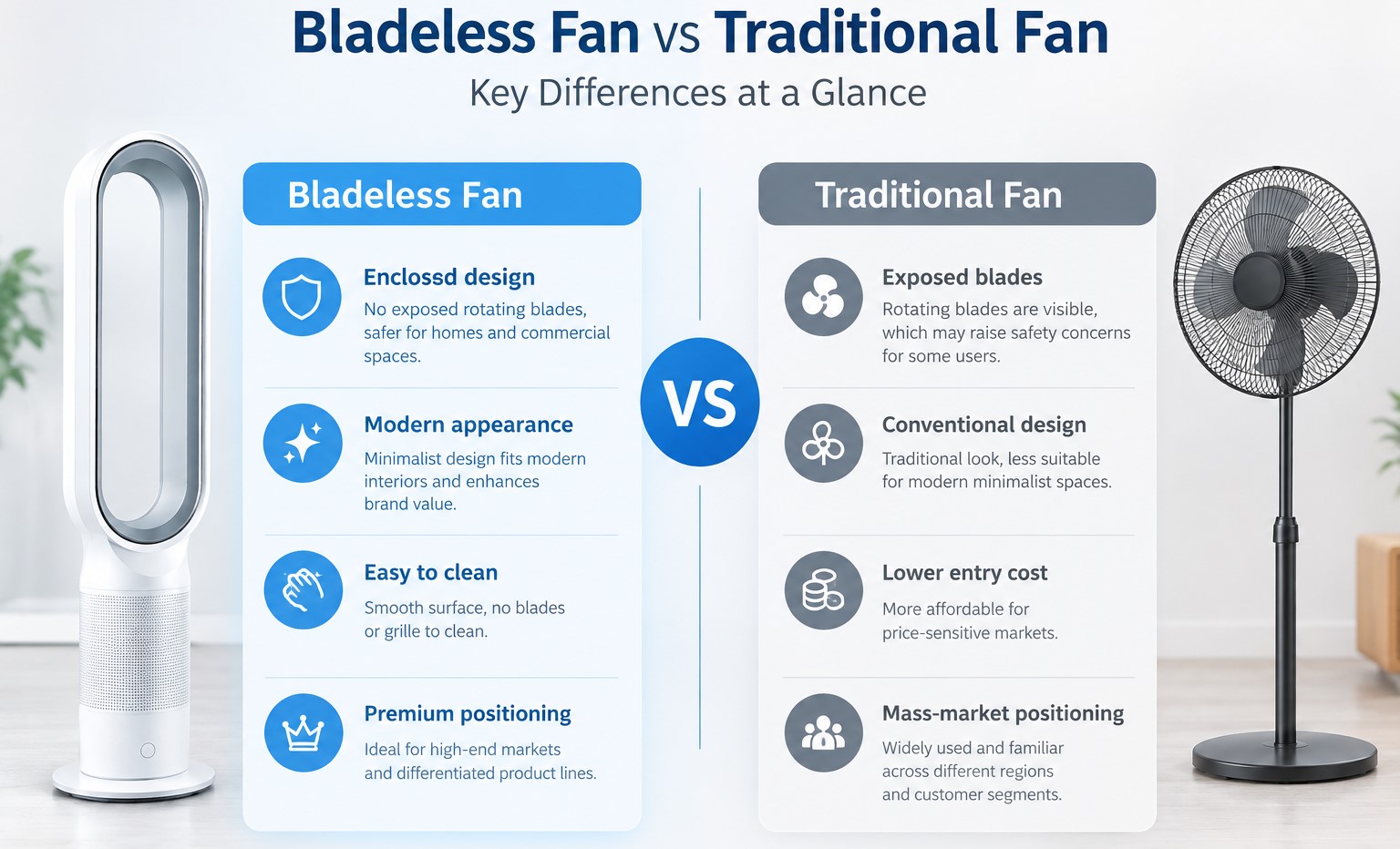
| Feature | Bladeless Fan | Traditional Fan |
|---|---|---|
| Blade exposure | No exposed rotating blades | Exposed rotating blades |
| Design | Modern and minimalist | Conventional |
| Cleaning | Generally easier | Blades and grille require cleaning |
| Product positioning | Premium and differentiated | Practical and price-focused |
| Purchase cost | Usually higher | Usually lower |
| Customization potential | Suitable for differentiated OEM/ODM products | Broad range of conventional designs |
| Target market | Premium, modern, safety-conscious customers | Value-focused and mass-market customers |
The better choice depends on what matters most to the buyer. A business targeting premium home appliances may prefer a bladeless fan, while a price-sensitive market may favor a traditional fan.
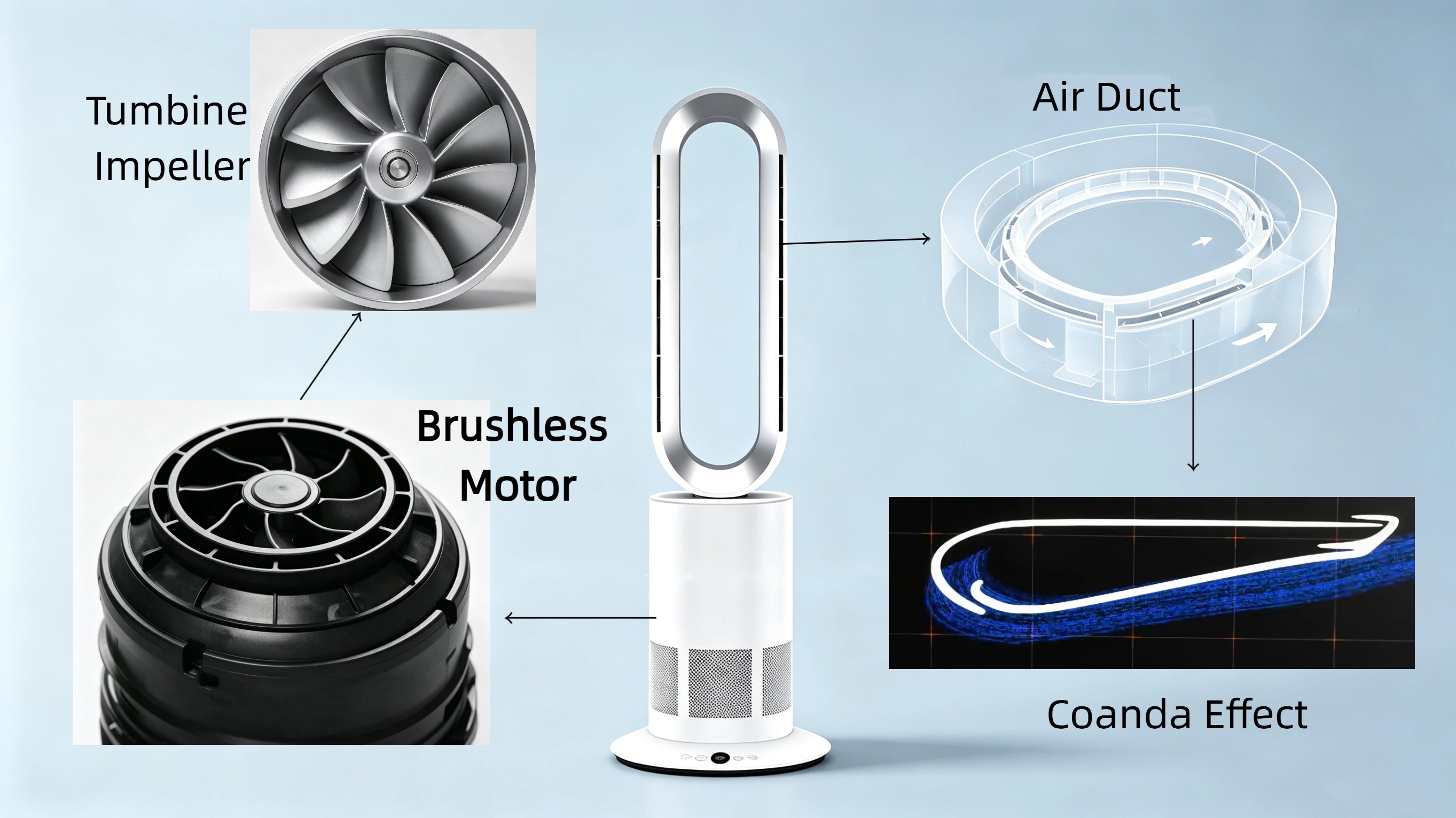
One of the most recognizable features of a bladeless fan is its enclosed airflow structure without exposed rotating blades. This can be an important product feature for businesses targeting customers who value safety-oriented product design.
For retailers and distributors, this design also creates a clear difference from conventional fans.
If you want to understand the airflow technology behind this design, see our guide on how bladeless fans work.
Bladeless fans typically have a minimalist appearance that fits modern residential and commercial interiors. This makes them suitable for product lines where appearance is part of the purchasing decision.
For businesses, design differentiation can help a fan stand apart from conventional products in a crowded appliance category.
Traditional fans commonly require cleaning around the grille and blades. A bladeless design can simplify access to the exterior surfaces because there are no exposed rotating blades to clean.
This can be useful for customers who prioritize convenient maintenance.
For B2B buyers, product differentiation is often as important as the basic cooling function. A bladeless fan gives distributors, retailers, and appliance brands an alternative to conventional fan designs.
With OEM and ODM manufacturing, businesses can also explore product appearance, colors, packaging, and other customization requirements according to their market.
Traditional fans are usually easier to position as cost-focused products. For businesses competing primarily on purchase price, a conventional fan can provide a straightforward solution for basic airflow requirements.
Consumers have used traditional fans for decades, so the product category is already familiar. This can make conventional fans suitable for mass-market channels where customers mainly compare price, airflow, size, and basic functions.
Traditional fans are available in many configurations, including table fans, pedestal fans, wall-mounted fans, and other conventional designs.
This broad selection allows businesses to choose products according to different applications and price levels.
The answer depends on your business model and target customers.
You target premium or modern home appliance markets.
Product appearance is an important selling point.
You want a more differentiated product category.
Your customers value an enclosed fan design.
You want to develop customized OEM or ODM products.
You are looking for products with stronger visual differentiation.
Purchase price is the primary concern.
Your customers mainly need basic airflow.
You compete in highly price-sensitive markets.
Your business focuses on conventional fan categories.
You need a familiar product type for mass-market sales.
For B2B buyers, the decision should therefore be based on market positioning rather than simply asking which fan is better.
Different applications can lead to different choices.
| Application | Recommended Choice |
|---|---|
| Premium home appliances | Bladeless fan |
| Modern residential spaces | Bladeless fan |
| Premium retail products | Bladeless fan |
| Basic household cooling | Either |
| Budget-focused products | Traditional fan |
| Price-sensitive markets | Traditional fan |
| Differentiated OEM products | Bladeless fan |
A business selling modern appliances may benefit from the design and differentiation of a bladeless fan, while a value-oriented product line may be better served by a traditional model.
For businesses looking for an air-cooling product with a modern enclosed design, an air cooling bladeless fan can be considered for residential, hotel and commercial applications.

Before selecting a fan supplier, B2B buyers should consider more than the unit price.
1. Target Market
Understand whether your customers prioritize premium design, affordability, safety-oriented features, or basic cooling.
2. Selling Price
Make sure the product's manufacturing cost fits your target retail or distribution price.
3. Product Positioning
Decide whether the product should compete through price, appearance, functionality, or differentiation.
4. Customization Requirements
If you need a private-label or customized product, confirm whether the manufacturer supports OEM and ODM development.
5. Supplier Capability
Evaluate manufacturing experience, quality control, customization capability, production capacity, and support for bulk orders.
Choosing the right bladeless fan manufacturer can be just as important as choosing between a bladeless and traditional fan.
Traditional fans are generally better for cost-focused applications where basic airflow is the priority. Bladeless fans can be a better choice for businesses seeking modern design, product differentiation, and premium positioning.
For wholesalers, distributors and retailers, a bladeless tower fan manufacturer can provide a more differentiated product option for modern appliance markets.
Not in every situation. Bladeless fans offer design and product-positioning advantages, while traditional fans can be more suitable for cost-sensitive applications.
A key design advantage is that bladeless fans do not have exposed rotating blades. However, overall product safety depends on the specific model and its safety design.
Noise performance depends on the specific fan design, motor, airflow system, and operating speed. Buyers should compare the actual specifications and test results of individual models rather than assuming one fan type is always quieter.
They can be worthwhile when modern design, product differentiation, enclosed construction, or premium positioning is important to your target market.
A bladeless fan can be a strong choice for premium, modern, and differentiated product lines. A traditional fan may be more suitable when low cost and basic airflow are the main priorities.

 86 13532762865
Online consultationalina1349@genjin.com
Hotline
+86 13532762865
7*24 hours service hotline