


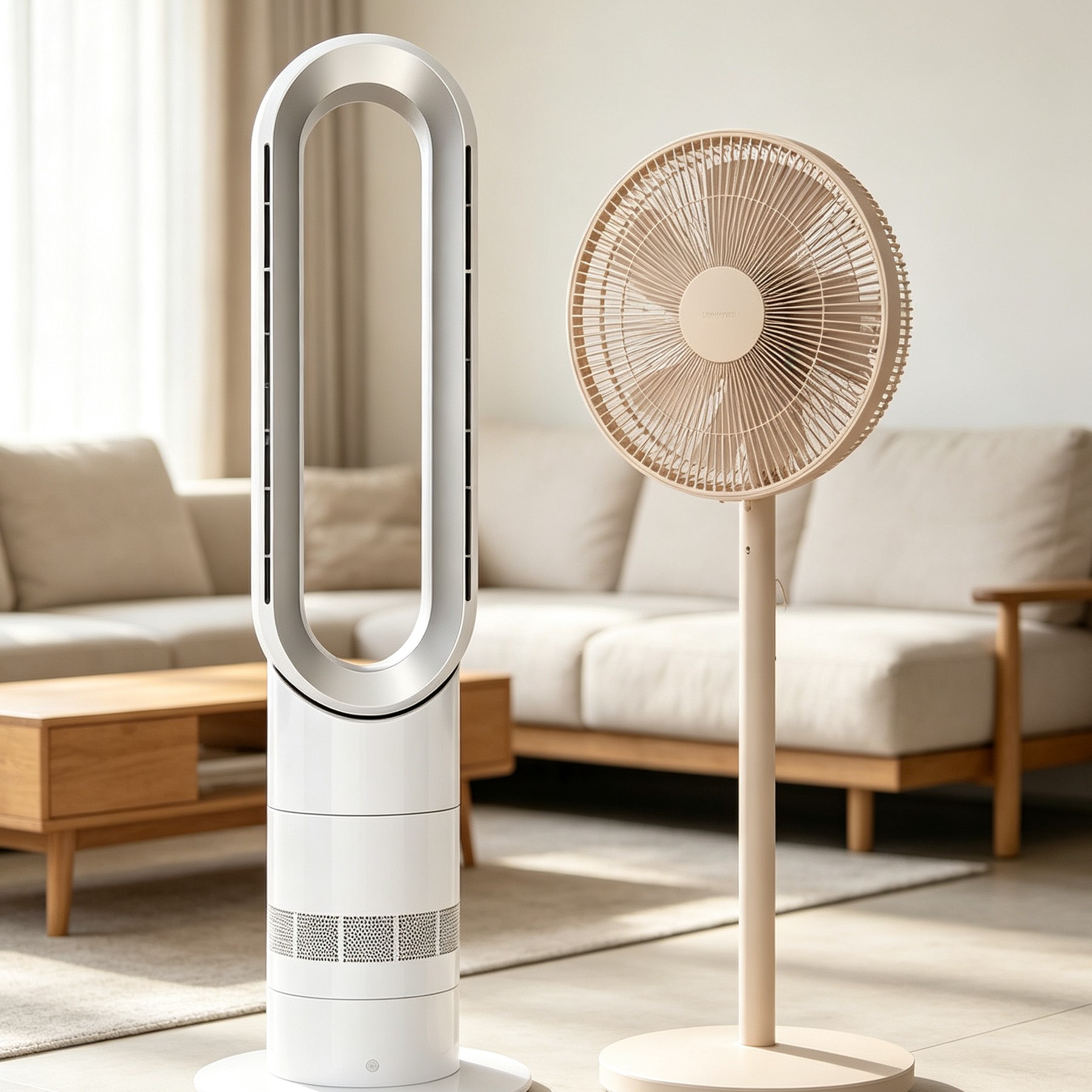
Choosing the right fan can significantly improve indoor comfort while reducing energy consumption. Today, consumers have more options than ever before, with bladeless fans becoming increasingly popular alongside traditional bladed fans.
Although both products are designed to circulate air, they differ greatly in airflow technology, safety, maintenance, energy efficiency, and overall user experience.
This guide compares bladeless fans and traditional fans across every important aspect, helping homeowners, retailers, distributors, and commercial buyers make informed purchasing decisions.
Traditional fans use exposed rotating blades driven by an electric motor to push air forward. They have been widely used for decades because of their simple design and relatively low manufacturing cost.
Common types include:
Table fans
Pedestal fans
Ceiling fans
Wall-mounted fans
Floor fans
Traditional fans remain popular because they provide strong airflow at an affordable price.
A bladeless fan uses air multiplier technology instead of exposed blades.
The motor draws air into the base of the unit and accelerates it through a specially designed air ring. This creates a smooth, uninterrupted stream of airflow that feels more natural and comfortable.
Unlike conventional fans, the airflow is continuous rather than choppy, making bladeless fans quieter and more pleasant for long-term use.
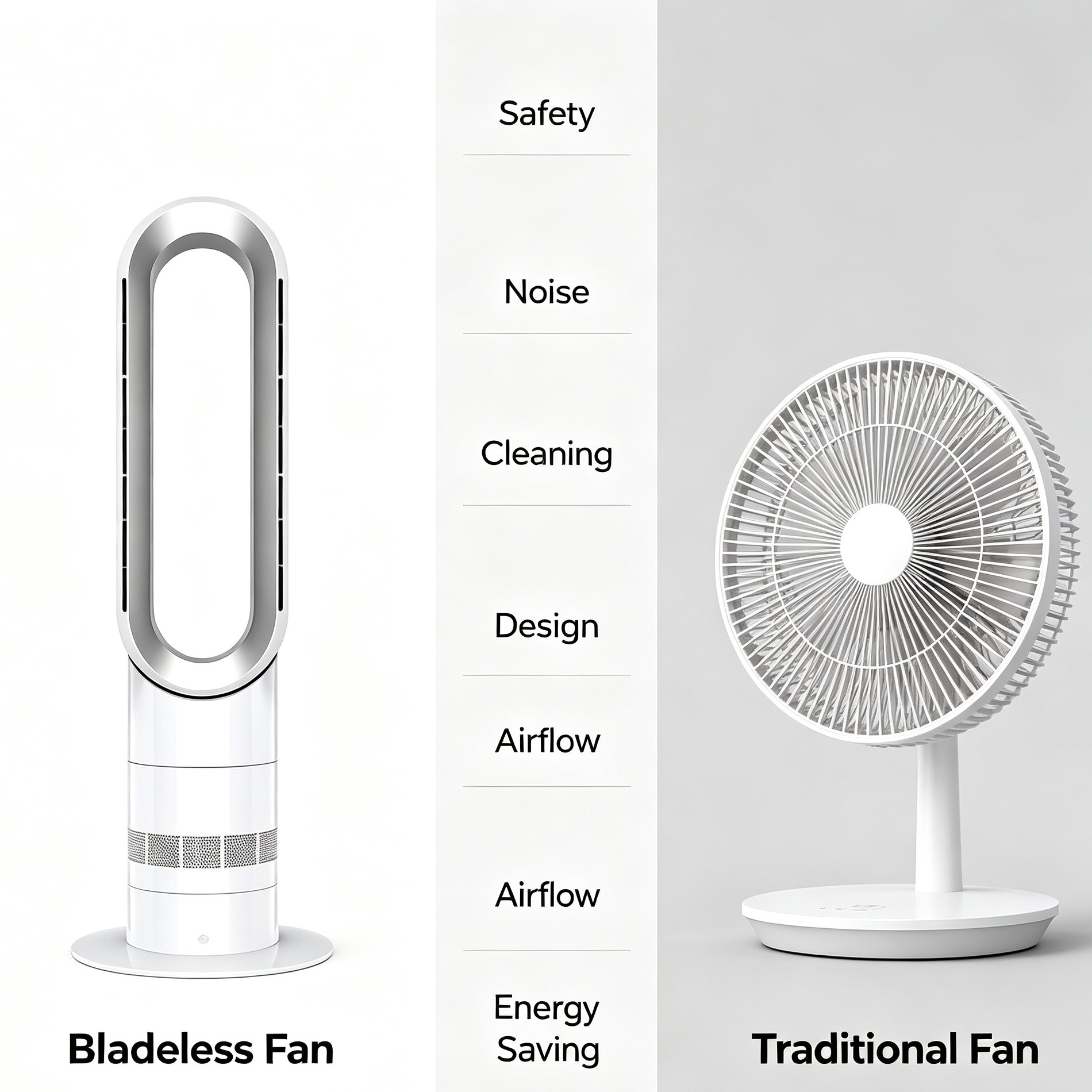
| Feature | Bladeless Fan | Traditional Fan |
|---|---|---|
| Safety | Excellent | Moderate |
| Airflow | Smooth & Continuous | Pulsed Airflow |
| Noise | Lower | Higher |
| Cleaning | Easy | Difficult |
| Appearance | Modern | Traditional |
| Energy Efficiency | High | Moderate |
| Smart Features | Common | Limited |
| Price | Higher | Lower |
One of the biggest advantages of bladeless fans is safety.
Because there are no exposed rotating blades, the risk of accidental injury is greatly reduced. This makes bladeless fans an excellent choice for:
Families with young children
Homes with pets
Schools
Hospitals
Nursing homes
Hotels
Traditional fans require protective grills, but fingers, hair, or loose clothing can still come into contact with moving blades.
Winner: Bladeless Fan
Traditional fans generate airflow in pulses as each blade rotates.
Bladeless fans produce a continuous stream of air through aerodynamic amplification technology.
Many users describe bladeless airflow as:
Softer
More natural
Less drying
More evenly distributed
For long periods of use, many people find bladeless fans more comfortable.
Winner: Bladeless Fan
Noise is another important consideration.
Traditional fans often become louder over time due to:
Blade vibration
Dust buildup
Motor wear
Modern bladeless fans are designed with optimized airflow channels and balanced motors, resulting in quieter operation.
This makes them ideal for:
Bedrooms
Offices
Libraries
Conference rooms
Baby rooms
Winner: Bladeless Fan
Both fan types consume far less electricity than air conditioners.
However, many premium bladeless fans feature:
DC motors
Variable speed control
Smart sensors
Sleep modes
These technologies can improve energy efficiency during extended operation.
Winner: Bladeless Fan
Cleaning a traditional fan usually involves removing the protective grille and washing each blade individually.
Bladeless fans have a much simpler exterior.
Most models can be cleaned by simply wiping the outer ring with a soft cloth.
Less dust accumulation also helps maintain consistent airflow performance.
Winner: Bladeless Fan
Many modern bladeless fans include advanced functions such as:
Remote control
Touch control
LED display
Wi-Fi connectivity
Voice assistant compatibility
Timer settings
Oscillation control
Traditional fans typically offer fewer intelligent features.
Winner: Bladeless Fan
Traditional fans generally cost less to purchase.
They are suitable for buyers with limited budgets or applications where appearance and advanced features are less important.
Bladeless fans have a higher upfront cost but provide added value through:
Improved safety
Modern aesthetics
Lower noise
Easier maintenance
Smart functionality
The total ownership experience is often worth the additional investment.
Winner: Depends on Budget
Bladeless fans are ideal for bedrooms, living rooms, and children's rooms because they combine safety, quiet operation, and stylish design.
The quiet performance and modern appearance make bladeless fans an excellent choice for offices and meeting rooms.
Luxury hotels increasingly choose bladeless fans to complement premium interior designs while providing guests with a quieter environment.
Modern retailers appreciate bladeless fans for their attractive appearance and enhanced customer safety.
Global demand for bladeless fans continues to grow as consumers prioritize safety, aesthetics, and smart home products.
Retailers benefit from:
Higher perceived product value
Premium pricing opportunities
Strong consumer appeal
Growing demand in online marketplaces
Better product differentiation
As a result, bladeless fans have become a fast-growing category for wholesalers, distributors, and private label brands.
When sourcing bladeless fans, consider manufacturers that offer:
OEM and ODM services
Stable production capacity
International certifications
Strict quality control
Low MOQ options
Global export experience
Product customization
Partnering with an experienced manufacturer helps ensure consistent quality and long-term supply.
Internal Link Recommendation:
Learn more about our Bladeless Fan Manufacturer services, including OEM, ODM, private label, and wholesale solutions.
(这里锚文本链接到你的核心页面。)
Yes. Without exposed rotating blades, bladeless fans are generally considered safer for children and pets.
Like traditional fans, bladeless fans do not lower room temperature but improve comfort by increasing air circulation.
Most modern bladeless fans operate more quietly than traditional fans, especially at low and medium speeds.
Many models equipped with efficient DC motors consume very little power, although actual energy usage depends on the specific model and operating speed.
Both bladeless fans and traditional fans provide effective air circulation, but they are designed for different priorities.
Traditional fans remain a practical and budget-friendly option, while bladeless fans offer superior safety, quieter performance, easier maintenance, and a more modern user experience. As demand for premium home appliances continues to grow, bladeless fans are becoming the preferred choice for homes, offices, hotels, and commercial environments.
For businesses looking to source high-quality products, partnering with an experienced Bladeless Fan Manufacturer can provide access to OEM customization, private label services, and reliable wholesale supply.
Choosing the right fan can significantly improve indoor comfort while reducing energy consumption. Today, consumers have more options than ever before, with bladeless fans becoming increasingly popular alongside traditional bladed fans.
Although both products are designed to circulate air, they differ greatly in airflow technology, safety, maintenance, energy efficiency, and overall user experience.
This guide compares bladeless fans and traditional fans across every important aspect, helping homeowners, retailers, distributors, and commercial buyers make informed purchasing decisions.
Traditional fans use exposed rotating blades driven by an electric motor to push air forward. They have been widely used for decades because of their simple design and relatively low manufacturing cost.
Common types include:
Table fans
Pedestal fans
Ceiling fans
Wall-mounted fans
Floor fans
Traditional fans remain popular because they provide strong airflow at an affordable price.
A bladeless fan uses air multiplier technology instead of exposed blades.
The motor draws air into the base of the unit and accelerates it through a specially designed air ring. This creates a smooth, uninterrupted stream of airflow that feels more natural and comfortable.
Unlike conventional fans, the airflow is continuous rather than choppy, making bladeless fans quieter and more pleasant for long-term use.
| Feature | Bladeless Fan | Traditional Fan |
|---|---|---|
| Safety | Excellent | Moderate |
| Airflow | Smooth & Continuous | Pulsed Airflow |
| Noise | Lower | Higher |
| Cleaning | Easy | Difficult |
| Appearance | Modern | Traditional |
| Energy Efficiency | High | Moderate |
| Smart Features | Common | Limited |
| Price | Higher | Lower |
One of the biggest advantages of bladeless fans is safety.
Because there are no exposed rotating blades, the risk of accidental injury is greatly reduced. This makes bladeless fans an excellent choice for:
Families with young children
Homes with pets
Schools
Hospitals
Nursing homes
Hotels
Traditional fans require protective grills, but fingers, hair, or loose clothing can still come into contact with moving blades.
Winner: Bladeless Fan
Traditional fans generate airflow in pulses as each blade rotates.
Bladeless fans produce a continuous stream of air through aerodynamic amplification technology.
Many users describe bladeless airflow as:
Softer
More natural
Less drying
More evenly distributed
For long periods of use, many people find bladeless fans more comfortable.
Winner: Bladeless Fan
Noise is another important consideration.
Traditional fans often become louder over time due to:
Blade vibration
Dust buildup
Motor wear
Modern bladeless fans are designed with optimized airflow channels and balanced motors, resulting in quieter operation.
This makes them ideal for:
Bedrooms
Offices
Libraries
Conference rooms
Baby rooms
Winner: Bladeless Fan
Both fan types consume far less electricity than air conditioners.
However, many premium bladeless fans feature:
DC motors
Variable speed control
Smart sensors
Sleep modes
These technologies can improve energy efficiency during extended operation.
Winner: Bladeless Fan
Cleaning a traditional fan usually involves removing the protective grille and washing each blade individually.
Bladeless fans have a much simpler exterior.
Most models can be cleaned by simply wiping the outer ring with a soft cloth.
Less dust accumulation also helps maintain consistent airflow performance.
Winner: Bladeless Fan
Many modern bladeless fans include advanced functions such as:
Remote control
Touch control
LED display
Wi-Fi connectivity
Voice assistant compatibility
Timer settings
Oscillation control
Traditional fans typically offer fewer intelligent features.
Winner: Bladeless Fan
Traditional fans generally cost less to purchase.
They are suitable for buyers with limited budgets or applications where appearance and advanced features are less important.
Bladeless fans have a higher upfront cost but provide added value through:
Improved safety
Modern aesthetics
Lower noise
Easier maintenance
Smart functionality
The total ownership experience is often worth the additional investment.
Winner: Depends on Budget
Bladeless fans are ideal for bedrooms, living rooms, and children's rooms because they combine safety, quiet operation, and stylish design.
The quiet performance and modern appearance make bladeless fans an excellent choice for offices and meeting rooms.
Luxury hotels increasingly choose bladeless fans to complement premium interior designs while providing guests with a quieter environment.
Modern retailers appreciate bladeless fans for their attractive appearance and enhanced customer safety.
Global demand for bladeless fans continues to grow as consumers prioritize safety, aesthetics, and smart home products.
Retailers benefit from:
Higher perceived product value
Premium pricing opportunities
Strong consumer appeal
Growing demand in online marketplaces
Better product differentiation
As a result, bladeless fans have become a fast-growing category for wholesalers, distributors, and private label brands.
When sourcing bladeless fans, consider manufacturers that offer:
OEM and ODM services
Stable production capacity
International certifications
Strict quality control
Low MOQ options
Global export experience
Product customization
Partnering with an experienced manufacturer helps ensure consistent quality and long-term supply.
Internal Link Recommendation:
Learn more about our Bladeless Fan Manufacturer services, including OEM, ODM, private label, and wholesale solutions.
(这里锚文本链接到你的核心页面。)
Yes. Without exposed rotating blades, bladeless fans are generally considered safer for children and pets.
Like traditional fans, bladeless fans do not lower room temperature but improve comfort by increasing air circulation.
Most modern bladeless fans operate more quietly than traditional fans, especially at low and medium speeds.
Many models equipped with efficient DC motors consume very little power, although actual energy usage depends on the specific model and operating speed.
Both bladeless fans and traditional fans provide effective air circulation, but they are designed for different priorities.
Traditional fans remain a practical and budget-friendly option, while bladeless fans offer superior safety, quieter performance, easier maintenance, and a more modern user experience. As demand for premium home appliances continues to grow, bladeless fans are becoming the preferred choice for homes, offices, hotels, and commercial environments.
For businesses looking to source high-quality products, partnering with an experienced Bladeless Fan Manufacturer can provide access to OEM customization, private label services, and reliable wholesale supply.

 86 13532762865
Online consultationalina1349@genjin.com
Hotline
+86 13532762865
7*24 hours service hotline